
BIT-0011: One Safety Dial, Two Opposing Jobs, No Valid Setting
What BIT-0011 proposes for subnet ownership on Bittensor, and why its one anti-sniping protection can't be calibrated. With an on-chain read of all 128 active subnets.
At POL we study market and mechanism design on-chain, and this post is part of that research. Everything here comes from the spec (PR #27) and an on-chain read of the network. BIT-0011 is an open draft, not a final design.
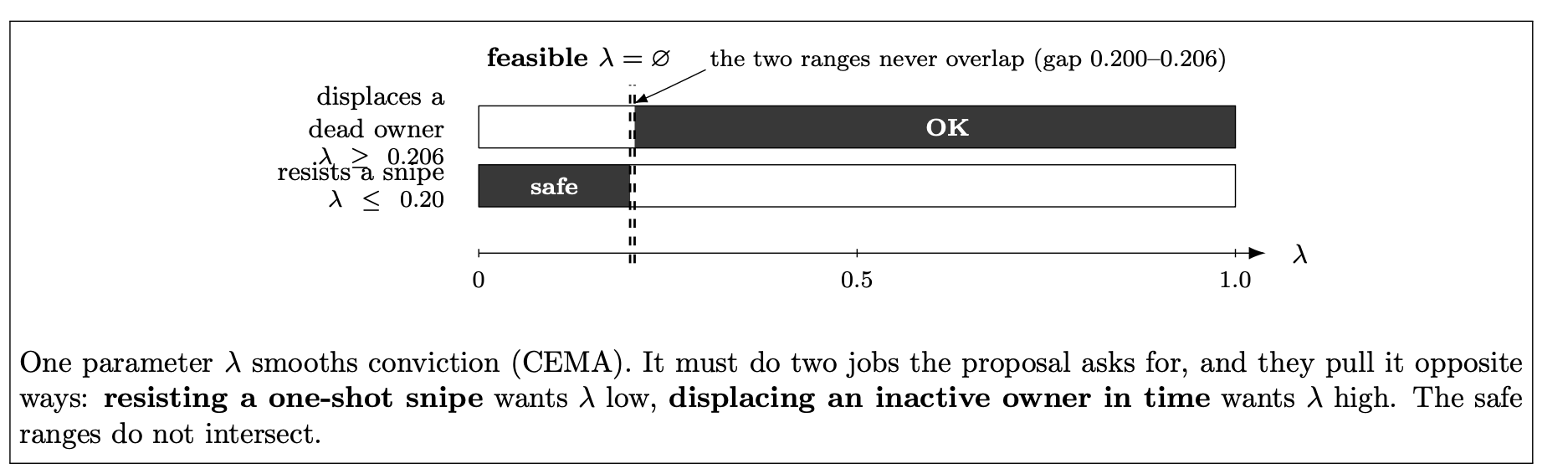
I'll get straight to the point, so if you bail here you already have the main thing: BIT-0011 replaces permanent subnet ownership with an ongoing contest based on something they call "conviction." Its entire anti-sniping defense rests on a single smoothing parameter, λ. The problem is that no value of λ works. To resist a last-minute attack you need λ low. To be able to remove an inactive owner within a quarter you need λ high. With sensible thresholds, what we found is that those two ranges don't overlap.
What exists today, and what BIT-0011 changes
Today each subnet has one owner, and that owner takes 18% of that subnet's alpha emissions, forever, whether they do anything or not. That creates dormant subnets where someone harvests 18% without contributing. Well, "without contributing" is a stretch: those people thought it up, invested early, and did the marketing. But the idea is that whoever earns all (or part) of the emissions should be someone working on the ecosystem day to day and making sure everything runs as it should.
BIT-0011 turns that into an open contest. Anyone can challenge for a subnet's "deed" by locking alpha to build what the proposal calls conviction:
- Conviction starts at the locked amount and decays linearly to zero at the lock's expiry.
- That raw conviction is smoothed with an exponential moving average (the spec calls it CEMA), where λ = update_period / lock_interval.
- Every
update_period= 216,000 blocks (~30 days), ownership passes to whoever has the highest smoothed conviction, as long as it clears a minimum threshold θ. The 18% emission then flows to the winner. - The moving average is, per the spec itself, the anti-sniping defense: a giant last-minute lock shouldn't be able to seize the subnet in one shot, because the smoothing gives the incumbent time to react.
One detail that matters: conviction is measured in the amount of alpha locked, not its dollar value. To have it, you have to actually hold the alpha.
The point: one dial, two jobs that contradict each other
Here's the finding. The spec asks the same λ for two things:
- (a) That a last-minute lock can't grab the subnet in one shot. This needs λ low: if history dominates, a one-epoch spike barely moves the smoothed conviction.
- (b) That a dead owner can be displaced within a quarter. This needs λ high: if λ is low, the owner's conviction takes too long to decay and you can't remove them.
Same dial, opposite directions. And when you put numbers on it: resisting the snipe (asking for at least a 5× capital barrier) requires λ ≤ 0.20; displacing a lapsed owner within a quarter requires λ ≥ 0.206. The interval that satisfies both, (0.200, 0.206), is empty.
An honest caveat: the exact thresholds (that "5×", that "one quarter") are our judgment calls, and if you move them, the edges of the interval move. What does not depend on the judgment call is that the two needs push in opposite directions. The conflict is structural, not an artifact of how we picked the numbers.
 ## It's not a free-for-all; ownership concentrates in a few big players
There's a second finding, from reading the 128 active subnets on-chain (block 8,364,794).
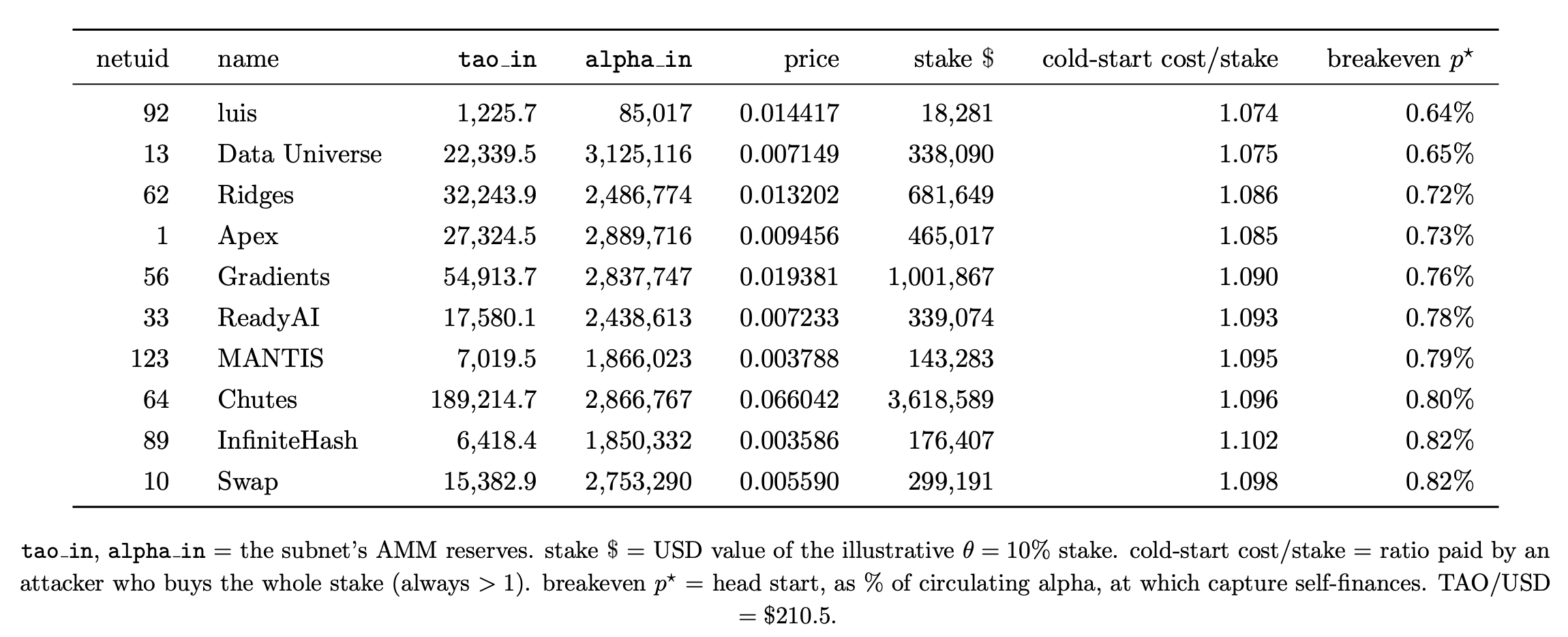
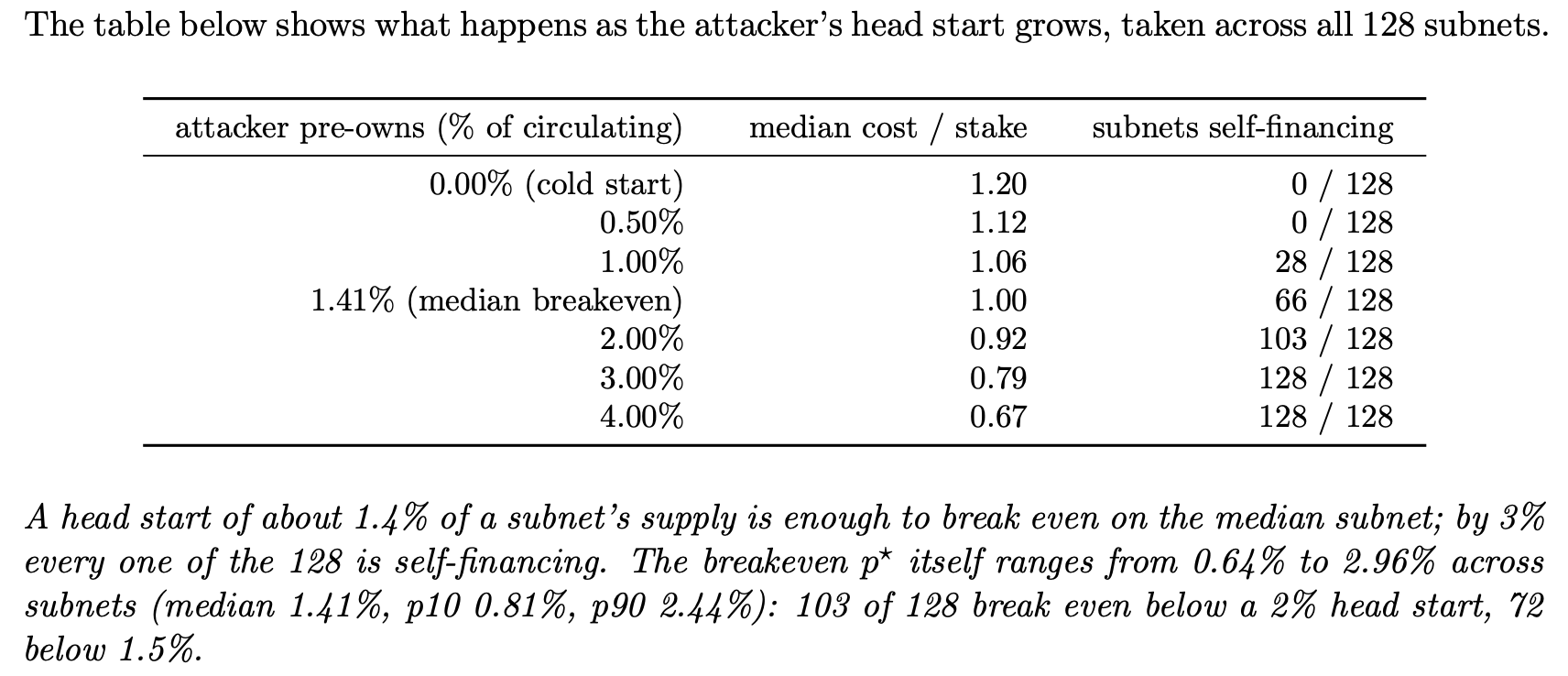
Because conviction is measured in the amount of alpha, capturing a subnet from scratch costs a median ~1.20× the value of the stake. That is: starting from zero, you always pay more than the prize. The only real lever is a head start. The pre-owned share at which capture self-finances is, at the median, ~1.41% of circulating alpha (range 0.64% to 2.96%). We use the median, not the mean, because a few subnets with very deep or very thin pools would drag the average; the median describes the typical subnet.
 Who's in position to do it? Today a non-owner already holds more alpha than the owner in 60 of 128 subnets. But in 54 of those 60, the larger holder is a recognized ecosystem entity, not an anonymous wallet: a DCG-backed accelerator like Yuma, subnet teams like Datura, plus infra and trading-wallet providers. Only 6 have an unknown wallet on top. The median owner stake is 15.6%; 53 of 128 are actively defended (owner with ≥20%); and 18 are practically abandoned (owner near 0%).
 In conlusion, BIT-0011 doesn't look like an open hunting season. It looks more like ownership ending up concentrated in a handful of large, recognized players (institutionals like Yuma, subnet teams, infra), with ~18 abandoned subnets left exposed.
The caveats, because they matter
- The "5×" and "one quarter" bars are model choices. The empty interval depends on those numbers; the directional conflict does not.
- We read current stake as a proxy for future locked conviction. BIT-0011 isn't live yet: nobody has locked anything.
- "A non-owner holds more" is an upper bound: coldkeys aren't clustered, so one of those wallets could be the owner's own second coldkey.
- The labels are heterogeneous: they mix funds (Yuma), teams/validators (Datura), and infra (DEXs and wallets like tao.bot or TAO.com). A wallet-labeled balance can be aggregated user stake, not a single entity ready to capture.
What's still open
- What
lock_interval(i.e. what λ) are you targeting, and which of the two goals are you willing to give up? As written, you can't have both. - Can a validator lock the stake delegated to it, or only its own coldkey's alpha? That decides whether the concentration is real.
- What happens to a subnet with no owner (when nobody clears θ): does it go to treasury, get burned, stay with the old owner? The spec doesn't say.
How we measured it
To answer the above with data and not assumptions, we built two tools, and I'm leaving the full results below and in the technical document.
-
An attack-cost map per subnet, across all 128. Result: in 103 of 128 subnets capture self-finances with less than a 2% head start. The full ranking, subnet by subnet, is in the dashboard and the doc.
-
A reconstruction of the owner-conviction series. Today the on-chain field that would show this is
null:get_metagraph_infoattributes delegated stake to validators, so nobody knows the real per-subnet conviction distribution. It's reconstructed from coldkey transaction history crossed with registration and lock events, and turns every "we assume X% conviction" into a measured number.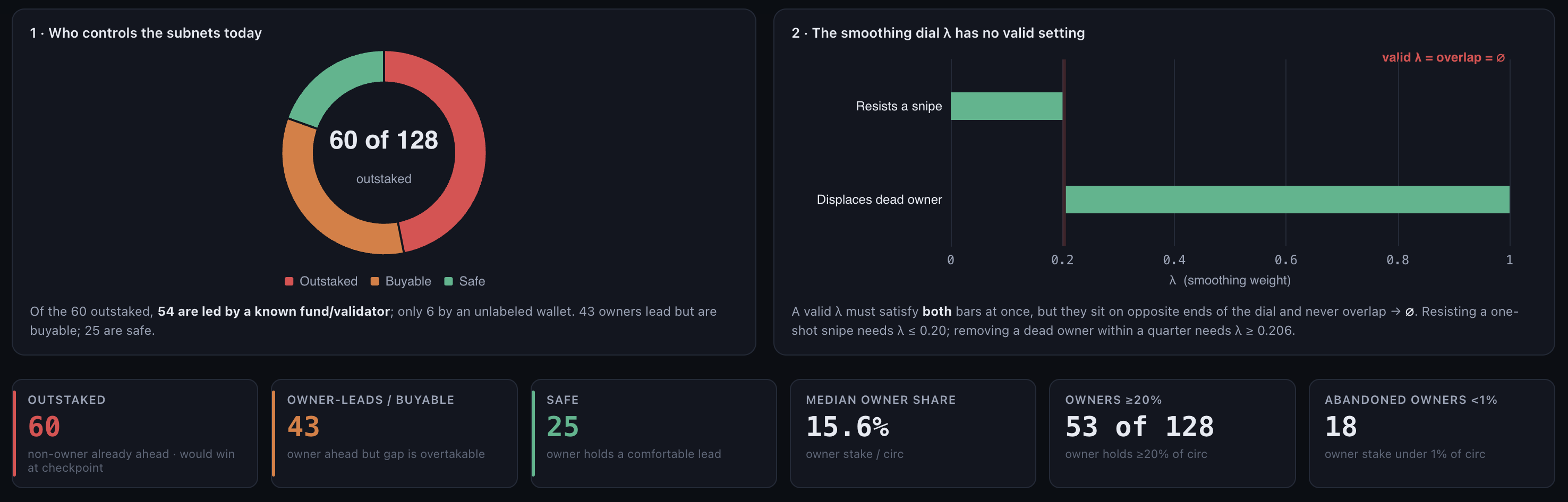
References
- BIT-0011 / PR #27, opentensor/bits (the open draft of the proposal)
- "Learn Bittensor" announcement: Locked Stake & Conviction for subnet ownership
- On-chain read:
finneynetwork via the Bittensor SDK, block 8,364,794 (2026-06-08, viewable on taostats); TAO price via DefiLlama - Full POL Finance technical document (calculations and caveats): on request